Realignment in the Ferghana: The Batken Infrastructure Gamble
Focus: geopolitical stability in Central Asia. Timeframe: from the February 2026 security-sector reshuffle in Kyrgyzstan to the late-March and 1 April 2026 cabinet move that placed land and real estate received from Tajikistan into Kyrgyz state ownership. The core finding is that the border settlement in and around Batken Region is no longer just a diplomatic agreement. It is now being implemented through fences, controlled roads, cadastral transfers, resettlement, and compensation. That is why Batken matters beyond the local level: it has become a live test of whether post-conflict stability in the Ferghana can be built by infrastructure before trust has fully returned.
The gamble is double-edged. On one side, the new model can reduce accidental contact points that used to trigger violence around roads, water, and mixed settlement patterns. On the other, it concentrates risk in a new set of friction points: damaged barriers, disputed compensation, delayed land allocation, weak local service delivery, and criminal adaptation along the remaining gaps. Batken’s new border regime may prove more governable than the old ambiguity, but only if the state can manage the social consequences as seriously as the engineering works.
A methodological note is necessary. No contemporary NGO dashboard appears to enumerate all households resettled during the 2025–26 exchange process. For that reason, this analysis uses official and local-source proxies such as houses built, compensated households, and land-allocation beneficiaries. Likewise, no public primary-source text defining “Project Fracture Point” was identifiable in this search, so the term is used here as an analytical lens rather than as a documentary source.
Why this matters now
The February realignment changed the institutional setting in which border implementation is taking place. On 10 February 2026, President Sadyr Japarov signed a decree transforming the Border Service out of the jurisdiction of the State Committee for National Security and appointing Abdikarim Alimbaev to lead the new State Border Service. At the same time, regional reporting and later analysis described a wider sidelining of allies of former security chief Kamchybek Tashiev. In practice, Batken entered the implementation phase of the border deal while its security chain of command was being simplified on paper but rebalanced politically in real time.
The April turn was equally important. The cabinet decision reported in late March and on 1 April 2026 moved transferred property into state ownership, turning the 2025 border treaty into an administrative reality. Parallel parliamentary explanations of the settlement showed how deep that reality runs: equal-area exchanges in several sectors, the assignment of mixed settlements, the neutralisation of the Tört-Kocho road junction, and the agreed construction of separate bypass routes for the Kyrgyz Min-Oruk–Samarkandek connection and the Tajik Vorukh–Isfara corridor. In other words, this is not merely a line on a map. It is a programme of spatial redesign.
The infrastructure gamble
The most visible part of the new strategy is physical hardening. Official and local reporting show that Batken began the 2026 fencing campaign on 1 March; by 9 April, 44.58 kilometres had already been installed, and the plan for 2026 is 200 kilometres more, after almost 150 kilometres were fenced in 2025. Regional coordination meetings also tied demarcation directly to anti-smuggling measures and to the protection of newly installed infrastructure. This is frontier management by wire, earthworks, and patrol rhythm.
The new road network shows the same logic. Field reporting by Radio Azattyk described the Min Oruk–Samarkandek overpass as a route raised past the Tajik village of Chorku, meant to stop the old pattern in which residents had to cut through or around each other’s settlements. Local officials told the outlet that the road should shorten travel, reduce dangerous crossings, and create fully independent movement for Kyrgyz communities; Tajikistan, in parallel, has begun its own bypass connecting Vorukh to Isfara. If one wanted a Batken version of “Project Fracture Point”, this is it: contested mobility is being transformed into segregated mobility.
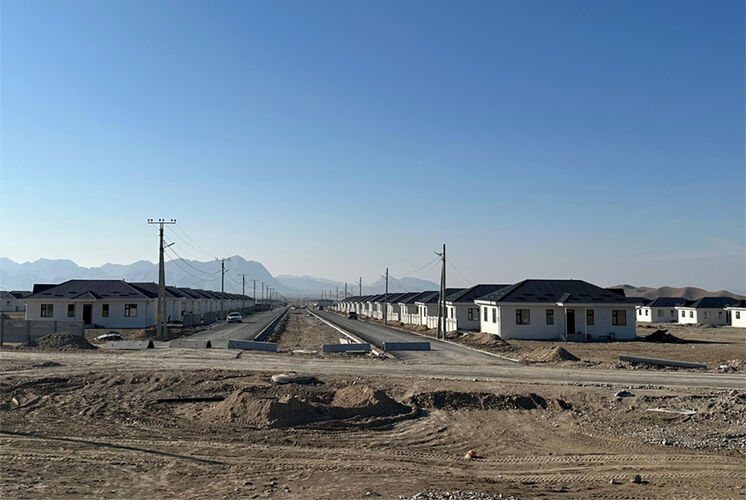
The resettlement side of the gamble is just as consequential. According to local and regional accounts, the resettlement planned after delimitation was completed by the end of 2025. New settlements included 181 houses on 57 hectares at Chet-Bulak and another 76 homes for residents in the Leilek sector; local reporting also says Tajikistan transferred 259 residential and social objects to Kyrgyzstan, while Kyrgyz authorities built 257 homes for their own citizens affected by the exchange. Compensation for lost outbuildings and perennial plantings reached hundreds of millions of soms, and local authorities have been redistributing agricultural land to households that lost plots in the exchange.
Security risks and resilience
There are early signs of tactical adaptation by local security institutions. Border representatives agreed dates for joint patrols in April 2026, and local cooperation drills were held in the Batken, Leilek, Isfara and Ganchin sectors. Kyrgyz customs officers were also deployed alongside border troops to install fencing in Samarkandek, while regional headquarters meetings explicitly linked demarcation to anti-smuggling enforcement and service readiness. These are practical improvements in local border-guard capacity. But they are happening while the wider security architecture is still digesting the February reshuffle, which means capacity may be more active on the ground than consolidated institutionally.
That leaves a serious residual risk of renewed clashes. The historical lesson from the 2021 and 2022 violence, underlined by Human Rights Watch, is that border agreements do not stabilise a frontier unless they also protect rights to housing, property, education and water. The new works reduce some flashpoints, but they also create new ones: fence-damage incidents, disputes over who may clear trees or structures on the line, delayed plot allocation before sowing season, or disruptions around newly neutral or bypassed roads. The danger is now less a return to undelimited chaos than a hard-edge dispute triggered by implementation failures.
The evidence base is stronger for criminal exploitation than for militant infiltration. Regional crime assessments published in 2025 describe active cross-border smuggling between Kyrgyzstan and Tajikistan, including illicit fuel and gold; local law-enforcement reporting in late 2025 and March 2026 documents organised smuggling channels in Leilek and large illicit pharmaceutical flows in Batken. By contrast, official meetings referred to the external situation in Afghanistan and Pakistan and ordered higher readiness, but the public record reviewed here does not show the same level of specific, attributable reporting on militant penetration into Batken. For policymakers, the implication is clear: criminal adaptation is the immediate threat vector, even if contingency planning for militant spillover remains necessary.
Social and economic effects
The social picture is mixed. Reporting by 24.kg from Kara-Bak shows how the old border economy collapsed after repeated closures: trade with neighbouring Tajik villages stopped, households fell back on agriculture, livestock and remittances, and local leaders said smuggling sharply decreased but did not disappear. Yet the recovery is uneven rather than absent. Separate reporting suggests Tajik entrepreneurs have returned to markets such as Ak-Turpak, buyers from Isfara are once again purchasing Batken produce, and bilateral trade in 2025 recovered sharply to more than $33 million. Even so, some pre-war border markets still had not resumed by March 2026.
For livelihoods, land is the decisive variable. Local reporting from Batken in February 2026 said roughly 400 hectares passed from Tajikistan to Kyrgyzstan and roughly 350 hectares went the other way; one Batken official said 337 hectares were being distributed to 986 citizens. Farmers interviewed by Radio Azattyk were explicit about the timing problem: they needed replacement plots before the spring field season, not after it. That matters because displaced or exchanged households often lost more than a house. They lost orchards, hay fields, irrigation rhythms and years of sunk labour in perennial crops. Compensation softens the blow, but it does not automatically restore productive time.
Service delivery is therefore central to resilience. New settlements are receiving schools, kindergartens, clinics, water and roads, with local reporting listing roughly 207 million soms for a school in Jany-Dostuk, 69.459 million for a kindergarten there, 22.5 million for a feldsher point, and another 82 million for a kindergarten in Razzakov. Concessional lending and special-status social payments are also part of the package. This matters because earlier reconstruction backed by the World Bank had already shown that rapid restoration of schools and health facilities can normalise daily life after conflict. But local voices still describe poor roads, weak water access, unemployment and outward migration as unresolved pressures on cohesion. Batken’s resilience problem is no longer emergency shelter; it is whether a rebuilt service ecosystem can keep communities economically and socially rooted.